Tuesday, July 3, 2018

Dances With Killdeer


Killdeer (Charadrius vociferus) using a distraction display.
Not a bad Tuesday morning. I took a few hours this morning to bird at my favorite spot along the Republican River and to try a new spot just North and it paid off.

The first big accomplishment of the day was observing my 125th species in Clay County, KS. I had been chasing this one for a while now and was super excited to finally hit the mark. My 125th species is a Mississippi Kite (Ictinia mississippiensis).

The second, and probably my favorite, thing was witnessing a Killdeer (Charadrius vociferus) performing a distraction display. I had witnessed other birds pretending to be hurt to try and draw you away from their nest, but since the Killdeer is one of my favorite birds anyway it made it so much more special to witness from this species.

I did not find the nest that this displaying bird was trying to pull my attention from, but I did later find another nest near where I had parked my car. The Killdeer sitting on this nest flushed as I approached my car, sparking my interest.

The second bird didn't perform a distraction display, sadly, but in the "nest" were three eggs. I put quotes around nest because these birds don't construct a nest the same way that a song bird does. Instead, the Killdeer nest was basically a small platform of sticks directly on the ground. The eggs are very nicely camouflaged to blend in with the surrounding rocks.
Killdeer (Charadrius vociferus) nest.

Both of the areas that I walked this morning were very productive, and I have come one step closer to documenting every Clay County species. There are more pictures attached in the checklists below.

eBird Checklists: https://ebird.org/view/checklist/S46959621

https://ebird.org/view/checklist/S46961308

Sunday, July 1, 2018

Ardea en Mass

What a morning.

I went to Fancy Creek State Park this morning to bird at one of my favorite spots while my wife ran the trail. It started off fairly well with a few Indigo Buntings (Passerina cyanea) and Dickcissels (Spiza Americana), but by the end was a checklist that I may never forget.

At Fancy Creek, there is a little paved loop that looks like it used to be a loading spot for boats, but is too overgrown now to drive down. This makes it perfect for walking to get some of the hidden birds. There wasn't a ton of variety at first, mostly just those Buntings and Dickcissels, but as I turned a corner to go down the rickety little bridge, I noticed three little Lark Sparrows (Chondestes grammacus) hopping along the pavement.

I crossed the bridge which then becomes a truly hidden road with lots of brush on either side. This little road always produces most of the species that I observe whenever I go to Fancy Creek.

Here I found a few Orchard Orioles (Icterus spurius), a Summer Tanager (Piranga rubra), and a beautiful Ruby-throated Hummingbird (Archilochus colubris) to name a few of my highlight species.

These weren't the birds that made my checklist so memorable though. By the end of my hour and 41 minutes, I had observed 33 Turkey Vultures (Cathartes aura), 12 Great Blue Herons (Ardea herodias), and 13 Great Egrets (Ardea alba). This is the largest group of Great Blue Herons and Great Egrets that I have ever seen.

Having this many Turkey Vultures and not being flagged for a high count also got me wondering, what is considered a high count for this species? If anyone has ever experienced a group larger than this or been flagged for a high count, please let me know in the comments.

eBird checklist: https://ebird.org/view/checklist/S46914805

Thursday, June 28, 2018

Close Encounters of the Harrier Kind

These past few days I have been enjoying some morning birding in the local cemetery. The cemetery in Clay Center is one of the few eBird recognized hotspots in town and for good reason.

Although Clay Center has been a part of the Tree City USA program for 42 years, the cemetery is one of the few places with a good proportion of trees, open space and water where I can find a nice diversity of birds.

On Tuesday I had observed 14 species, with my second reported sighting of a Western Kingbird (Tyrannus verticalis) in Clay County.

On Wednesday, I was able to take the youth pastor from the First Presbyterian Church out with me. We were able to identify 13 species, but had an amazing experience with a Northern Harrier (Circus hudsonius).

As we were standing near the mossed over remnants of the pond, observing the Baltimore Orioles (Icterus galbula) as they danced around the mulberry tree, I noticed a little disturbance off to our left. We both turned to see what it was.

The first thing to come to our minds was that it was a Mourning Dove (Zenaida macroura). We then quickly realized that it was being chased by a robin sized bird and that it was much too big to be a Mourning Dove.

The mystery bird zipped by us, and felt close enough that we could reach out and touch it.

From these observations we were able to determine that it was a grey colored raptor of some sort. Our first assumptions made us think that it was a falcon of some sort, mostly due to size. The only problem with this, is that the only falcon species that is typically around our area this time of year is the American Kestrel (Falco sparverius) which is smaller and more colorful than the bird that we observed.

After discussing for a little bit on what we had just seen, I came to the conclusion that maybe it was a Northern Harrier. So, I pulled up my Merlin app, looked up Northern Harrier, and conferred with my partner. We determined that, in the end, it was most likely a Northern Harrier than any of the falcon species that we were thinking it to be.

Having someone with me to share this close encounter made the experience more enjoyable for me because we now have something in common. He has also decided to download the eBird and Merlin apps to continue his birding adventures.

Checklist for Tuesday June 26
https://ebird.org/view/checklist/S46805386

Checklist for Wednesday June 27
https://ebird.org/view/checklist/S46825812

Tuesday, June 26, 2018

Even the Common Birds Can Change Your Day

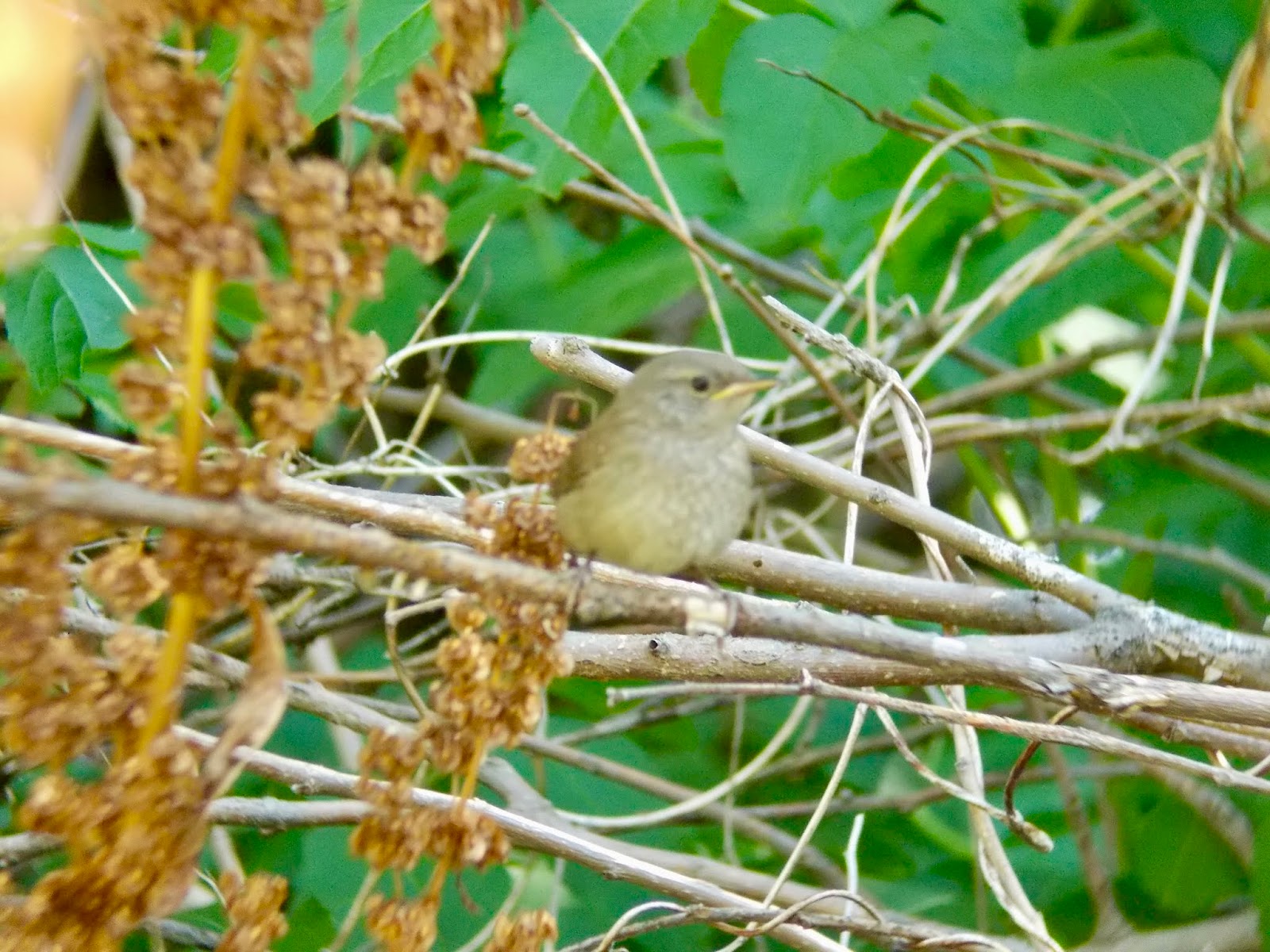
Although this picture of a House Wren (Troglodytes aedon) is a little blurry, it was definitely my highlight of the day. 


This Monday was an amazing day for birding here in Clay County, Kansas. We had lots of rain throughout the night on Sunday and most of Monday morning, creating nice cool temperatures for some afternoon birding.

I headed to my favorite birding location along the Republican River. I'm not afraid to tell you where this is because it is public land and anyone can access it. I also believe that if someone wants to experience what you have while birding then what is it hurting to share your best locations?

I wasn't seeing or hearing much at first. I had just passed the first little pullout along the road that runs parallel to the river, and was just about to reach the corner that I like to call sparrow corner, when I heard a House Wren (Troglodytes aedon) whisper-screeching at me.

I stopped to observe the frantic little bird and soon noticed that there were two of them. I watched for a while to see if they were protecting a nest or if there was a young fledgling. Then, from the depths of the brush pile, came a third. I quickly reached around to my bag to get my camera, thinking that these little guys would surely be zipping off soon, but they actually hung around and let me take a few photos of them.

This little experience completely changed my attitude for the rest of the trip, and I ended up observing 25 species in about two miles. Maybe not my best outing, but definitely an example how even a common bird, like a House Wren, can change the outcome of your entire day. I was about to turn around and go home until those three little birds let me pester them with my camera for a while.

Attached below is my eBird checklist from this outing if you would like to check it out.

https://ebird.org/view/checklist/S46794722

Sunday, June 24, 2018

Introduction

Hello, my name is Austin Roe, I am currently a junior at Kansas State University studying Fisheries, Wildlife and Conservation. During the Summer of 2017, I worked for the Missouri Ozark Forest Ecosystem Project (MOFEP) bird crew. On the MOFEP crew, we conducted point counts in forest stands that are being harvested in different ways to see how they may affect bird populations. This is where I first started learning how to identify birds by both sight and sound. I have also helped mist net and band birds on the Konza Prairie. Most importantly, I am an avid eBirder.

A lot of people ask me, "Why would you count birds?" Which gives me the opportunity to inform them on how you can go birding anywhere and any time and how it can help to support conservation.

Birds are all around us and I think it's really fun to see how a species can be in two totally different environments during the same time of the year.

My long term birding goal is to go birding in all 50 states. So far I am up to six, and they haven't always been the most productive outings. So if you like my posts and have a great birding spot in your area that I should check out, don't be afraid to let me hear about it.

I encourage people to get out and go birding, but also to try taking a friend with you and teach them how to identify birds. You might be amazed at how much you can share with someone and how much you can learn by teaching them about birds that you might identify every day.

I also encourage you to teach a child about birding. It's always great to get young people interested in any outdoor activity, especially one that is educational and can help to get people involved in conservation.

If you are a birder, you may have heard of a birding big year. If you're not a birder or you haven't heard of a birding big year, it's a challenge that you can set for yourself, or to compete against other birders and try to observe as many species as you can.

So come join me as I try and live my Birding Big Life.